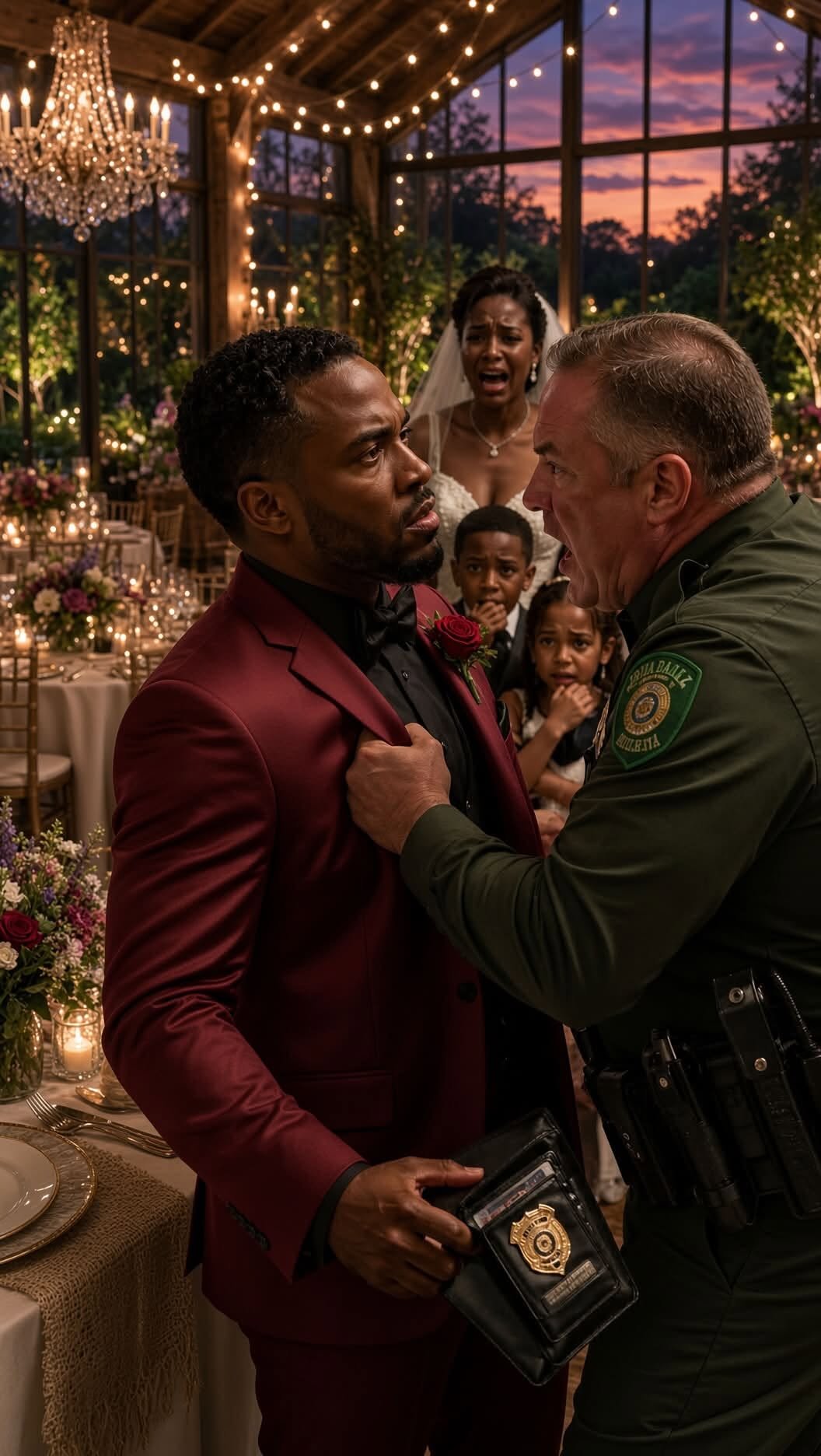
POLICE STORMED OUR BLACK WEDDING—THEN THE GROOM HANDED THEIR CAPTAIN ONE
BUSINESS CARD
PART 1
Six hours before eight officers entered my wedding, I stood before a
mirror fighting with a white bow tie. My name is Benjamin Carter. That
morning I did not want to be a prosecutor or the state attorney general.
I wanted to marry Rebecca Monroe.
My father, Pastor David Carter, pushed my hands aside and fixed the tie
himself. At seventy, Dad still treated me like the boy who once forgot
his shoes before Sunday service.
My phone kept vibrating with congratulations from colleagues, courthouse
staff, neighbors, and friends. I turned it facedown. For one day, I
wanted the title on my business card to be irrelevant.
I had no idea that before the night ended, a police captain would force
everyone in the room to confront exactly what a title could—and could
not—change.
PART 2
Rebecca chose Magnolia House, a restored estate outside the fictional
city of Bellhaven. White roses lined the garden aisle. For our families,
the place carried history. Decades earlier, Black families in the region
would not have been welcomed at many estates like it. Now three
generations were gathering there to celebrate.
My grandfather Isaiah Carter arrived in a charcoal suit with the
silver-tipped cane he hated using. At seventy-eight, he still taught
history whenever anyone stood still long enough to listen.
He inspected my suit.
“Too expensive.”
“It’s rented.”
“Still too expensive.”
Then he hugged me and whispered that my grandmother would have loved the
flowers.
PART 3
Among our guests was Sarah Mitchell, an investigative reporter and
friend of Rebecca’s. She was there socially, not to investigate
anything, though she had agreed to write a short feature about the
wedding.
Around midafternoon, Sarah noticed patrol vehicles circling the
property. One passed twice. Another slowed near the entrance.
She asked the venue manager whether police had been requested.
No.
No disturbance had been reported. No medical emergency. No complaint
from staff.
Sarah made a note on her phone and returned to the ceremony
preparations.
Reporters rarely stop noticing patterns, even at weddings.
PART 4
The ceremony began before sunset. Rebecca walked toward me beneath
strings of warm lights and I forgot every prepared sentence in my head.
“Breathe,” she whispered when she reached me.
“I am breathing.”
“You’re performing breathing.”
I laughed.
Dad officiated. Rebecca cried during my vows. I cried during hers.
Grandpa Isaiah cried and immediately denied it.
For forty minutes, the world became exactly as small as I wanted it to
be: two people, two families, one promise.
Then we moved inside for dinner and dancing.
At 8:17 p.m., the first police vehicle entered the estate drive.
PART 5
Venue cameras later reconstructed the timeline. By 8:21, eight officers
had entered the main doors.
Captain Dean Mercer walked first.
The music stopped.
Mercer looked across a ballroom filled with Black families and said,
“What zoo did you animals escape from?”
For a second, nobody moved. The sentence was so openly racist that the
room seemed unable to process it.
Then phones began rising.
I stepped forward.
“Officer, this is a private wedding. Can you tell me why you’re here?”
Mercer shoved his palm against my chest.
“Shut your mouth, boy.”
I stumbled backward.
Rebecca shouted my name.
Children moved behind their parents.
PART 6
Officers spread through the room. Mercer demanded to know who was
“dealing” and made another racist remark about the guests.
My father started toward me.
“Dad, stay there.”
I kept my hands visible.
Grandpa Isaiah was slower to obey.
“There are children here,” he told Mercer.
Mercer grabbed him by the jacket collar and pushed him toward a marble
wall.
“Face the wall, Grandpa. Probably got warrants anyway.”
My mother screamed.
Anger narrowed my vision, but training mattered most when anger was
justified.
I did not reach for Mercer. I did not shout threats.
I asked again why we were being detained.
PART 7
Across the room, Sarah began livestreaming. At first only a few hundred
people watched. Then viewers shared it.
She narrated only what she could observe: police had entered a private
wedding; the captain had used racist language; guests were being ordered
to remain in place; an elderly man had been pushed against a wall.
She did not claim to know why officers had been dispatched.
That restraint later mattered.
Evidence becomes weaker when observation and assumption are mixed.
Within minutes, thousands of people were watching the same scene we were
living through.
PART 8
Mercer laughed when I asked for the legal basis of the detention.
“You a lawyer?”
“Yes.”
“Everybody’s a lawyer when cops show up.”
A younger officer named Lena Price stood several feet behind him. She
had not drawn her weapon. She kept looking toward Mercer as if she also
wanted an explanation.
See more on the next page