Some matters resolved through a confidential civil settlement.
It was not a fortune.
No amount could price twenty years of scars anyway.
Part of the settlement funded burn-survivor counseling and home
gas-safety programs.
That was my choice.
I did not want Thomas Ward’s last act in my life to be a check.
I wanted something useful to exist because the truth finally surfaced.
Elias donated separately.
I almost refused.
Then I decided the program could use his money more than my anger could.
PART 23
One year after our wedding, Elias and I were still legally married.
We were not living together.
On our anniversary, he sent no gift.
He texted:
I know today is complicated. I hope you are gentle with yourself.
I replied:
Thank you.
It was the first message I had sent without anger.
Three weeks later, we had dinner.
Then another.
We did not call them dates.
Eventually I stayed late at his apartment.
He touched my face.
Then stopped.
“May I?”
I nodded.
His fingers traced the scar along my jaw.
This time I did not cry because I felt safe from being seen.
I cried because I no longer needed invisibility to feel lovable.
That difference changed everything.
PART 24
We did not renew vows.
Not then.
Grand gestures had become suspicious to me.
We rebuilt with ordinary things.
Shared grocery lists.
Therapy appointments.
Arguments completed instead of abandoned.
Passwords offered but not demanded.
Questions answered.
Elias told me every part of his father’s story he remembered.
Even the ugly parts.
Especially those.
I told him more about the explosion.
Not because he already knew the facts.
Because he had never known my experience.
The smell of antiseptic.
The first time I saw my reflection.
The classmate who screamed when she saw me after surgery.
The boy at seventeen who kissed me on a dare.
Elias cried.
I let him.
PART 25
Two years after our wedding, I moved back in.
It was not forgiveness completed.
It was trust under reconstruction.
There were conditions.
No hidden boxes.
No delayed truths because he thought he was protecting me.
No deciding what I could survive.
Elias agreed.
Then he added a condition of his own.
“You stop deciding what I think about your face before I get to tell
you.”
I stared at him.
“That’s annoyingly fair.”
“I’ve been practicing.”
I laughed.
That night, he asked me:
“Do you still wish I could never see you?”
I thought for a long time.
“No.”
“Good.”
“Why?”
“Because if medicine ever fixes my eyes, I don’t want our marriage to
collapse.”
I threw a pillow at him.
He missed it completely.
PART 26
Years later, a specialist told Elias that experimental treatment might
restore a small amount of light perception.
Not normal vision.
Possibly shapes.
Contrast.
Maybe nothing.
He asked what I thought.
The old version of me would have panicked.
Instead I said:
“What do you want?”
“To try.”
“Then try.”
The treatment helped slightly.
Months later, Elias could distinguish bright windows and some large
forms at close range.
One evening, I stood in front of him.
“Can you see me?”
“A shape.”
“Very romantic.”
“Wait.”
He moved closer.
Light from the window fell across my face.
“I can see where you are.”
My throat tightened.
“Is that scary?”
“No.”
“Why not?”
“Because I already know who’s there.”
PART 27
My father eventually forgave Elias before I expected him to.
Not completely.
Dad remained angry about the twenty-year silence.
But one afternoon, I found them sitting together.
Dad was describing an old photograph of me at age twelve.
“Her hair was ridiculous,” he said.
“Dad!”
“It was.”
Elias smiled.
“I wish I could have seen it.”
“No, you don’t,” Dad said.
That was the first joke between them.
Later Dad told me:
“I still think he was wrong.”
“He was.”
“I also think fifteen-year-old boys make terrible custodians of adult
guilt.”
“Yes.”
“And thirty-five-year-old men should know better.”
“Yes.”
Dad nodded.
“Good. Just checking.”
PART 28
Raymond Ward apologized once.
I accepted the words.
I did not invite him into my life.
Forgiveness and access are different things.
Thomas could never apologize.
For years, that bothered me.
Then I stopped needing the dead to complete conversations they had
abandoned.
I had his confession.
I had the truth.
That had to be enough.
On the twentieth anniversary of the explosion, I went to the empty lot
where my childhood house had once stood.
Elias came with me.
We brought nothing.
No flowers.
No ceremony.
I stood there until the memory stopped feeling larger than the land
itself.
Then I took Elias’s hand.
“Ready?”
“Yes.”
We walked away.
PART 29
People sometimes hear my story and say:
“So you married the son of the man who scarred you?”
Technically.
But that sentence turns people into inherited crimes.
Elias was not Thomas.
I was not merely what Thomas did.
The harder truth was that Elias had made his own serious mistake.
He hid information that belonged to me.
He let fear make decisions on my behalf.
That was his wrongdoing.
Not his father’s.
And if I forgave him, it had to be for what Elias did.
Not because he suffered enough for Thomas.
Children should not inherit guilt any more than they should inherit
innocence.
We answer for our own choices.
That became the rule our marriage finally learned.
PART 30
On our tenth anniversary, Elias sat at the church piano after everyone
left.
I stood beside him.
“Play the terrible wedding song.”
“The children murdered that song.”
“They gave it character.”
He played.
Halfway through, he stopped.
“Mara?”
“Yes?”
“Do you regret marrying me?”
I considered lying.
Then smiled.
“I regret that you let me marry you without the truth.”
He nodded.
“But I don’t regret what we built after I had it.”
His hands remained on the keys.
“That’s more than I deserve.”
“Don’t do that.”
“What?”
“Decide what you deserve for me.”
He laughed softly.
“Right.”
Then he began playing again.
EPILOGUE
I used to believe I married a blind man because he could never see my
scars.
That was the story I told myself.
It felt romantic.
Safe.
Almost poetic.
But it was also built on fear.
I thought love would be easier if the person loving me could not see the
thing I hated most about myself.
Then, on our wedding night, I discovered Elias had known more about
those scars than almost anyone alive.
He knew the address.
The date.
The explosion.
His father’s confession.
He knew before our first coffee.
Before our first kiss.
Before he asked me to marry him.
That truth nearly ended us.
Maybe it should have.
For a while, I believed the greatest betrayal was that Elias’s father
had caused the explosion.
It wasn’t.
Thomas Ward was responsible for his own choices.
The betrayal inside my marriage was simpler.
Elias possessed a truth about my life and decided when I was allowed to
know it.
He called that fear.
At times, he called it protection.
Eventually, he called it what it was.
Wrong.
That mattered.
Not because confession erased the harm.
Because repair cannot begin while someone is still defending the thing
that broke you.
I also had truths to confront.
I had spent twenty years believing my scars made me less desirable.
Then I chose a man whose blindness seemed to remove the possibility of
visual rejection.
I had mistaken being unseen for being safe.
They are not the same.
Safety is being known and still having choice.
That is what Elias took from me on our wedding day.
And what we spent years rebuilding afterward.
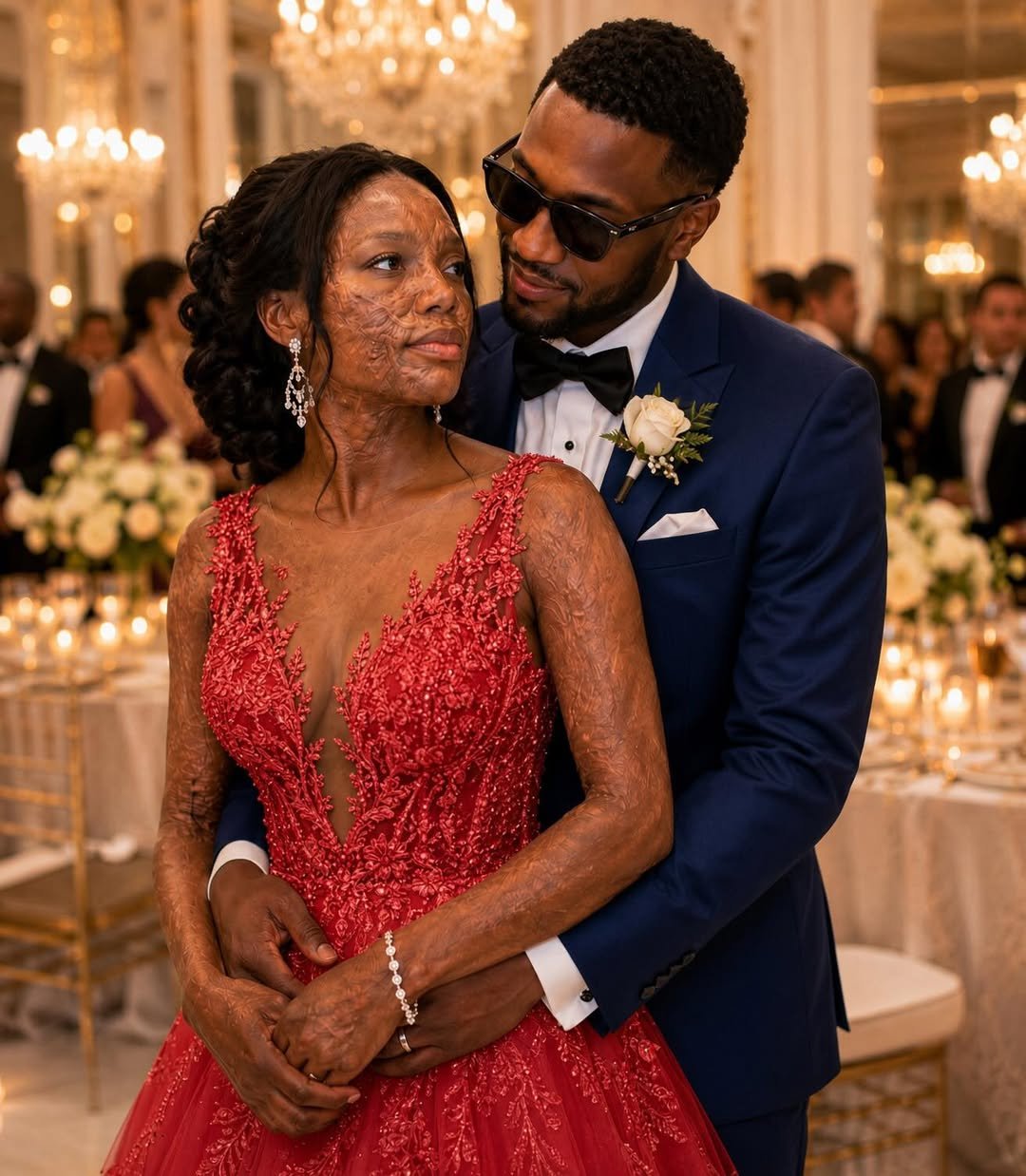
Today, the portrait from that photography session still hangs in our
home.
My face is turned directly toward the camera.
The scars are visible.
No retouching.
No hiding.
Elias cannot see the photograph the way most people can.
His limited light perception lets him locate the frame when sunlight
hits the glass.
Sometimes he stands in front of it and says:
“There you are.”
I always answer:
“You can’t even see me.”
And he says:
“I know.”
Then I laugh.
Because now I understand something I did not understand at thirteen.
Something I did not understand at thirty-three.
Being seen is not about flawless skin.
And being loved is not about finding someone incapable of noticing what
you fear.
It is about standing in the truth without disappearing.
My scars are still there.
Elias’s blindness is still there.
His father’s confession is still in a secure archive.
Our wedding night is still part of our marriage.
Nothing was magically erased.
That is not what healing did.
Healing changed who controlled the story.
For twenty years, an explosion controlled mine.
Then secrecy did.
Now I do.
And if I could speak to the thirteen-year-old girl lying beneath
hospital lights while adults called her lucky, I would tell her:
You are not lucky because you survived beautifully.
You are not lucky because someone will someday overlook your scars.
You are lucky only in the simplest sense.
You are alive.
The rest will not be given to you.
You will build it.
Slowly.
Painfully.
Honestly.
And one day, you will stop asking whether someone can see your scars.
You will ask whether they can see you.
That question changed my life far more than the secret Elias carried for
May you like
- I came home eleven months early without telling anyone and found my wife sitting against a wall with her head shaved and her face bruised, while my mother shouted at me to throw her out
- I Married a Blind Man So He’d Never See My Scars On Our Wedding Night, He Revealed the 20-Year Secret Behind the Explosion
- I lost my hotel job when a rich guest accused me of taking her $5,000 diamond ring. The next morning a security guard rang me: “Come back. You need to see what that woman left behind for you.”
- Eight Months Pregnant, My Husband Shoved Me Out of the Car onto the Shoulder of the Highway and Said, “You’re Bad Luck. You Don’t Deserve to Sit in This Car.” He Never Knew I’d Already Found Out About His Other Wife.
- MY HUSBAND HURT ME FOR REFUSING TO LET HIS MOTHER
twenty years.
And unlike the explosion, the answer finally belonged to me.
See more on the next page