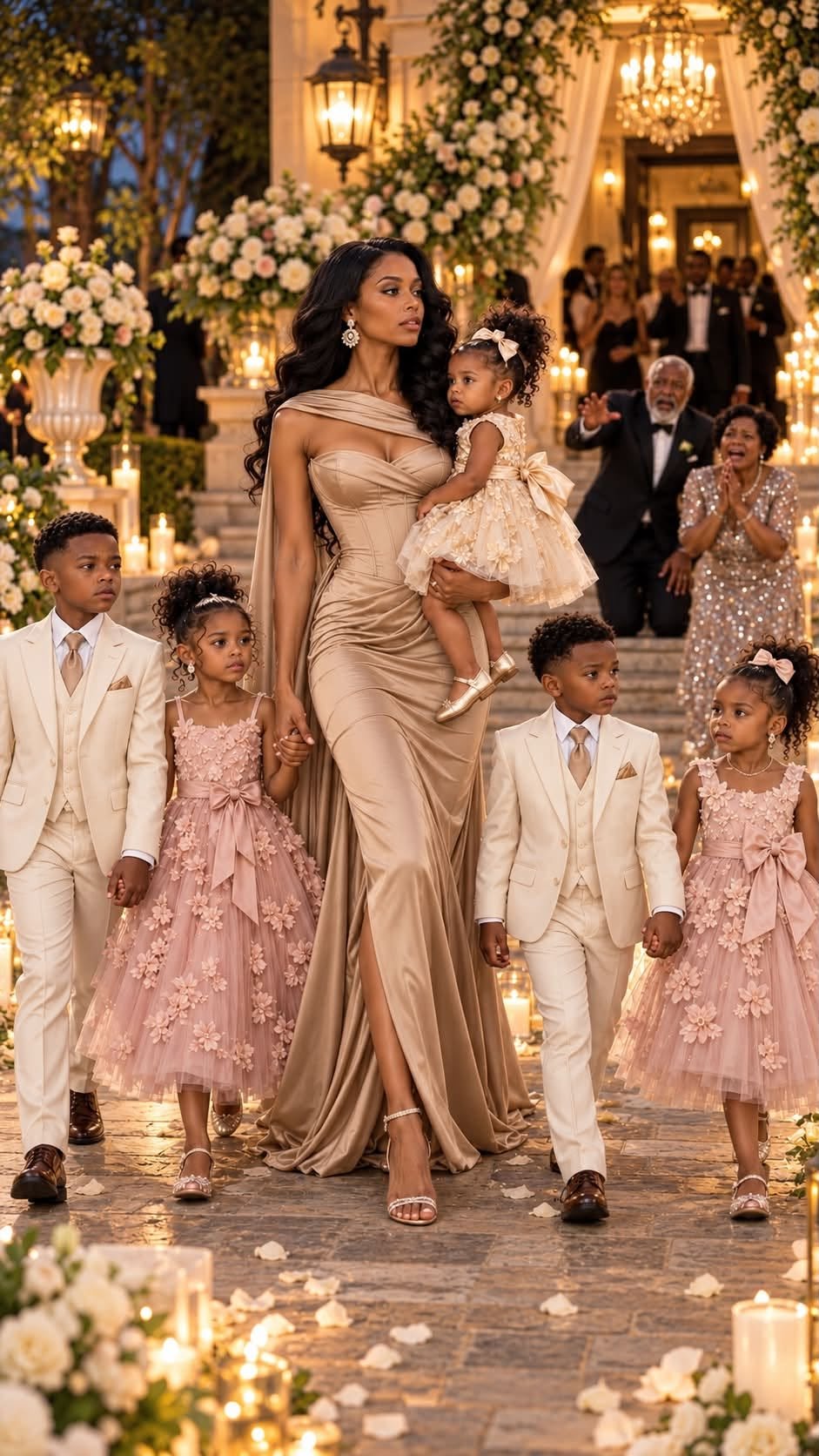
MY FATHER-IN-LAW THREW ME AND MY SIX CHILDREN INTO THE RAIN—THEN I TOLD
HIM TO CHECK THE NAME ON THE DEED
PART 1 — EIGHT DAYS
The rain came down hard enough to sting.
Eight days after burying my husband, I stood outside the iron gates of
the only home my children had known.
My eleven-month-old daughter Rose clung to my chest beneath my soaked
coat. Five more children stood behind me: Isaac, fourteen; Jonah,
twelve; Emma, nine; Luke, seven; and Sophie, four.
Two black trash bags sat in a puddle beside us.
Standing beneath the covered entrance was my father-in-law, Graham
Bellamy.
Dry. Warm. Smiling.
“Get off my property, Hannah.”
“These are your grandchildren.”
My mother-in-law, Lenora, stepped beside him. “You were never one of
us.”
Isaac stepped forward. “Dad said Mom could stay here. I heard him.”
Graham struck him.
My son stumbled.
Something inside me went completely still.
“Do not touch my child again.”
Graham laughed. “What exactly are you going to do? You have no money. No
influence. No Bellamy name.”
Lenora threw another bag outside. The seam split and children’s clothes
spilled into the mud.
“We changed the locks. This house belongs to the Bellamys.”
For fourteen years, I had swallowed their insults for Owen’s sake.
Owen was dead now.
My silence did not need to survive him.
PART 2 — THE YELLOW FOLDER
I gathered the children and started toward the road.
Then the diaper bag bumped my hip.
The yellow folder.
Three weeks before Owen died, he had pressed it into my hands.
“If my parents ever try to force you out, find Vivian Mercer.”
“Who?”
“An attorney. Promise me.”
I promised, then grief swallowed everything.
Halfway down the driveway, I stopped and turned.
“Before you celebrate, you might want to check whose name is actually on
the deed.”
Graham froze.
Lenora’s expression changed.
That was when I knew Owen had been afraid for a reason.
I did not read legal papers in the rain.
A neighbor, Mrs. Calder, saw us near the road and stopped her SUV. One
look at Isaac’s face and the soaked children was enough.
“Get in.”
At her house, she found towels, dry clothes and hot chocolate.
Only then did I open the folder.
The first page was a letter.
Hannah,
If you are reading this because my parents tried to remove you from the
house, I am sorry. I wanted to believe grief would make them kinder. I
could not risk our children discovering I was wrong.
Under it were property records, trust papers, insurance information and
a business agreement.
Then a card:
VIVIAN MERCER — ESTATES & TRUSTS.
I called.
PART 3 — THE LAWYER
Vivian answered quickly.
“Hannah Bellamy?”
“How did you know?”
“Owen told me you might call.”
I started crying.
“They threw us out.”
“When?”
“Tonight.”
“Are the children safe?”
“Yes.”
“Are you safe?”
“Yes.”
“Good. Do not return alone.”
I asked about the deed.
Vivian paused.
“Hawthorne Ridge is not owned by Graham Bellamy.”
“Who owns it?”
“A trust Owen established. Under the documents I prepared, you are the
current trustee, subject to the trust terms.”
The house had once belonged to Graham and Lenora. Years earlier,
Graham’s development business had nearly collapsed. Owen had helped
stabilize family assets and eventually acquired the property through a
company he controlled. Later, as his health worsened, it was transferred
into a trust.
Graham and Lenora had occupancy rights.
They did not own the property outright.
Neither did I personally own it like a simple private house.
That distinction mattered.
“Do not threaten to throw them out,” Vivian warned. “We handle occupancy
lawfully.”
“I don’t want revenge.”
“What do you want?”
I looked at my children.
“Their home back.”
PART 4 — ISAAC
Before property came my son.
Isaac insisted he was fine.
He was not.
I documented his visible injury and contacted law enforcement. An adult
had struck my child. I wanted an official record.
That night Isaac sat beside me.
“Dad knew Grandpa might do this?”
“I think he feared it.”
“Why didn’t he tell us?”
“He was dying.”
Isaac stared at the floor. “I should’ve stopped Grandpa.”
“You are fourteen.”
“He hit me because I talked back.”
“He hit you because he chose to.”
I took his hand.
“You never carry that for him.”
The next morning Graham called.
“You opened Owen’s folder.”
“Yes.”
“You have no idea what those papers mean.”
“That’s why I called the attorney who prepared them.”
Silence.
“Come home. We’ll discuss it.”
“No.”
“Hannah, you’re making a terrible mistake.”
I looked at Rose sleeping beside me.
“No, Graham. I think I finally stopped making one.”
PART 5 — WHAT OWEN KNEW
Vivian met me with another sealed letter.
Owen wrote that his parents had always believed family assets should
remain under their control even when the legal ownership said otherwise.
As his illness worsened, Graham pressured him to restore control over
business interests. Lenora asked about education funds established for
the children.
Owen refused.
They may treat my death like an opening, he wrote. I am trying to close
it before I go.
The house was only part of his planning.
There was life insurance, retirement money, education trusts and a
business interest.
We were not suddenly unimaginably wealthy.
But we were not destitute.
Graham knew that.
When he told me I had nothing, he was counting on me not knowing what
existed.
Vivian showed me correspondence in which Graham had asked Owen to
“restore family control.”
Owen had declined in writing.
For the first time, I understood the yellow folder was not a surprise
attack Owen had designed against his parents.
It was a shield.
PART 6 — LENORA
Lenora came to Mrs. Calder’s house.
Vivian was present.
“Hannah, this has gone too far.”
“You threw six children into a storm.”
“We were emotional.”
“You changed the locks before the funeral flowers died.”
“We thought you would go to your sister.”
“You thought wrong.”
Her eyes hardened.
“Owen was manipulated.”
“By whom?”
“You.”
I almost laughed.
Vivian stopped the conversation before it became useless.
“Further property discussions should go through counsel.”
Graham demanded a family meeting with aunts, cousins and uncles.
I refused.
Vivian said, “You do not need twenty relatives voting on legal
documents.”
That sentence changed something in me.
For fourteen years, Bellamy decisions happened around long tables.
Everyone spoke. Graham decided. Then the family called it consensus.
Some meetings are not designed for agreement.
They are designed for pressure.
My answer was no.
See more on the next page