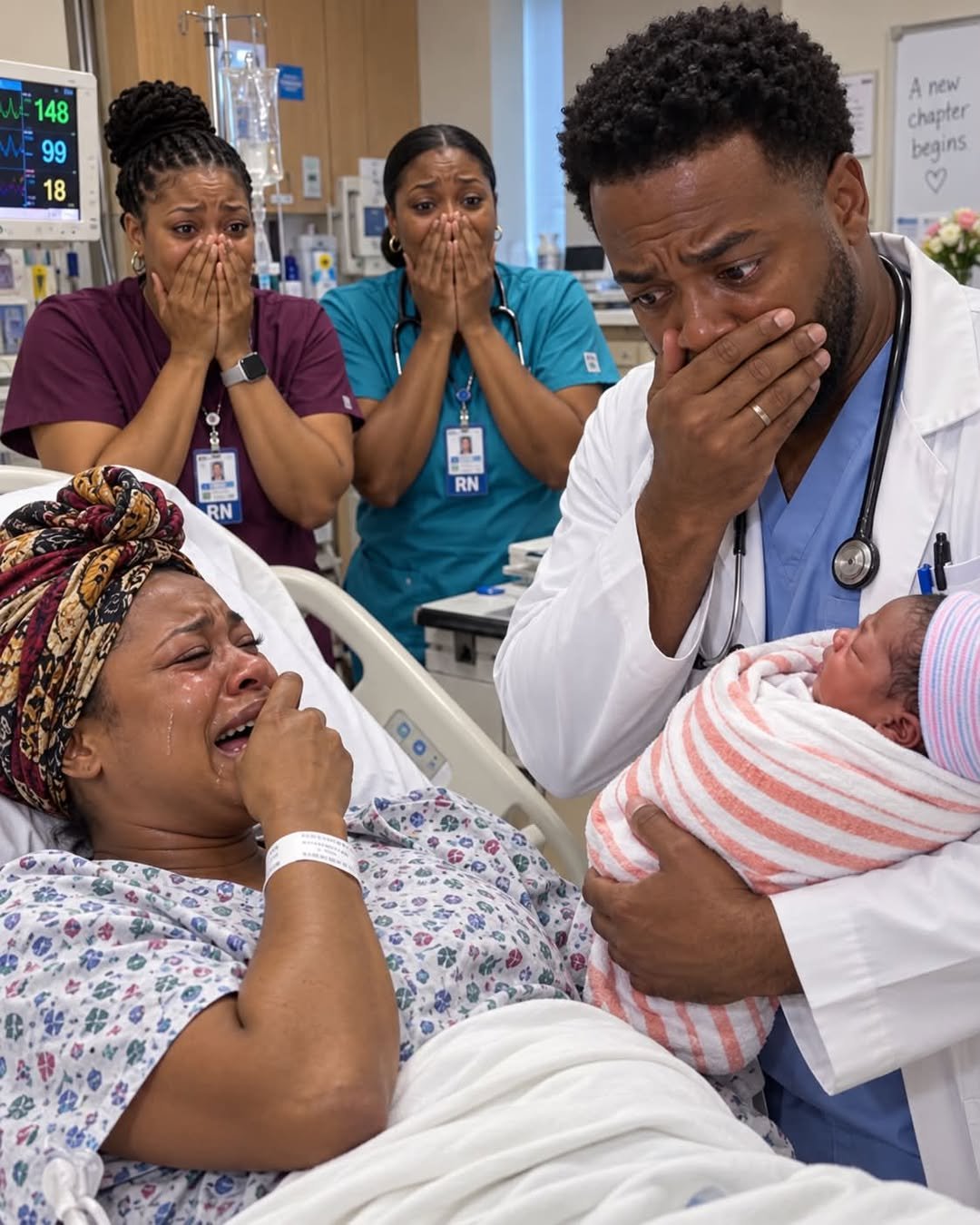
He made me alone. And then he came to the hospital at twenty past six in the morning to hold it against me.
He had a solicitor waiting in the car park. I found that out later. Somebody had rung him the moment I was admitted, because he still had my name flagged on something at that hospital through the insurance he had cancelled.
The doctor said, very quietly, that I needed to rest and that everybody else needed to leave.
Tobiah said he was the father and was entitled to be there.
And the doctor looked at him for a long time and said: I know.
I did not understand that either. Not for another hour.
About twenty minutes later I was in a wheelchair in the corridor outside the nursery. They had taken my son through for his checks and the blind on the window was down.
There were about eighteen people in that corridor. Midwives, a porter with a trolley of towels, two families waiting to go in and see their own.
And his mother came down it, in her good coat, with a folder.
She had not come to see the baby either.
She got hold of my wrist and she said it loud enough for every single one of them:
Sign it, Alethea. You can’t even afford a car seat.
Nobody moved. A midwife set a clipboard down on the desk.
She did not let go. She leaned in and said:
Just sign. Well?
And I did not look at her.
I was looking past her.
Because the doctor had come out of the nursery doors behind her, and he had stopped dead in the middle of that corridor.
And he was not looking at me.
He was staring straight at Philippa Wrexham.
PART 4
My son was born with a small streak of white hair at the front of his head.
About the width of my thumb, right at the hairline, against hair that is otherwise completely dark.
It is a family trait. It is harmless and it is rare, and it runs straight down a line from parent to child, and it has a name that I did not know that morning and that I have since looked up about forty times.
The doctor who delivered him has one.
His name is Leander Moss. He is sixty-one. His hair is mostly grey now and you have to look for it, but it is there, over his left eyebrow, whiter than the rest.
He had heard the name Tobiah Wrexham before. Thirty-six years ago, in 1990.
He was a junior doctor that year. Twenty-five. And he had a relationship, for about seven months, with a married woman called Philippa Wrexham, who was twenty-seven and very unhappy and who had married into a family with a very old name and a very large house.
She had a son that spring.
And then she cut off all contact, in one letter, and told him the baby was her husband’s, and that if he ever came near her family she would tell her husband a version of events that would end his career before it started.
He was twenty-five. He believed her. He moved hospitals.
He has told me since that he thought about that child on every birthday for thirty-six years and never once allowed himself to look him up, because he had promised, and because he was frightened of what he would find.
And then, at eleven minutes past six on a Tuesday morning, he lifted a newborn out of a stranger and saw his own hairline.
That doctor had just delivered his own grandson.
That is why he cried. That is why he asked. That is why his hands went tight on that blanket when I said the name.
And now the part that I have not been able to stop laughing about, in a way that is not really laughing.
The woman standing in that corridor with a folder — who stood behind her son three months earlier and told me that I had fallen pregnant to get my hands on the money —
had done exactly that herself, in 1990, with another man’s child, to keep a very large house and a very old surname.
She accused me of using a baby to secure a fortune.
She was the only person in that entire family who ever had.
And then there is the white hair.
Tobiah has it too.
He has dyed it since he was thirteen.
His mother made him. He told me once, early on, laughing, in bed, that she had said it made him look unwell in school photographs, and that she had marched him to a salon the week it came through properly and he had been going every five weeks ever since.
He has no idea why. He has never once asked.
He is thirty-six years old and he has been colouring over his own father every five weeks since he was a child, because his mother told him to, and he thought it was about photographs.
Leander Moss did not make a scene in that corridor.
I have thought about that a great deal since, because he had thirty-six years of reason to.
He walked up to her. Quite slowly.
She turned round, because everybody else in that corridor was looking at something behind her, and she saw him.
And I watched a woman of sixty-three recognise a face she had not seen since 1990, in about half a second, and I watched every single thing about the way she was standing change.
She let go of my wrist.
He did not say anything clever. He said her first name. Once. The way you would say it to somebody you used to know.
And then he said: he’s got it, Philippa. The baby’s got it.
That is all. Seven words.
She did not deny it. She did not say anything at all. She stood there with that folder in her hand for about four seconds and then she walked out of that corridor and got into the lift, and she did not come back that day or any other day.
Tobiah was standing about six feet away.
He had heard all of it, and he did not understand one word, and I watched him not understand it.
And then Leander looked at him — properly, for the first time — and put one hand up to his own forehead, to the white patch over his eyebrow.
And I watched my ex-husband, who has checked his reflection in every window he has ever walked past, put his own hand up to his own hairline.
It took him about eleven seconds.
He did not say anything either. He took the application out of his jacket, looked at it, and put it back in his pocket, and then he sat down on one of the plastic chairs along that wall and put his head in his hands.
That application was never filed.
The folder under my mattress went to Harrowgate and Vell the following week — to a woman I used to work with, who read the first four pages and rang me back inside an hour.
The divorce was settled in the June, and it was settled on terms that I am not going to set out, and they are fair, and the house is sold, and I have a flat and a car seat.
The companies that exist on paper and nowhere else are now somebody else’s problem, and somebody else is being very thorough about them.
Philippa has not been in touch. I do not expect her to be.
Tobiah sees his son twice a month, supervised for now, and he has not missed one. He has stopped dyeing his hair. The white came through in about eleven weeks.
He has had a DNA test. He has met Leander four times, in a café, with nobody else there, and I have never asked what they talk about.
PART 5
Now my part, and there is no honest version of this without it.
I did not ring my mother.
We have not spoken since the wedding. She came to it and she sat at the back and she left before the speeches, and the week before, at her kitchen table, she had told me exactly what that family was — very plainly, in about four sentences — and I had told her she was jealous and that she had never liked anything that was mine.
I had her number the entire way to that hospital.
I had it through three months of cleaning offices at night on an industrial estate with my ankles swelling over my shoes.
I had it when I was printing emails two pages at a time at a library so the woman on the desk would not notice.
And I would rather drive myself through red lights on the ring road at five in the morning, in labour, on my own, than make one phone call to a woman who was going to say she had told me so.
That is what I actually did.
They froze my account. They cancelled my insurance. They told my friends I had cheated.
They did not cut the line to my mother. I did that myself, in 2018, over a kitchen table, because she was right and I could not stand it.
Everybody who has heard this story says the same thing. That I was so strong, doing it all on my own.
I was not strong. I was proud, and those are two different things, and the second one nearly cost me my son.
Because the whole of Tobiah’s application — the whole of it, page two, no support network — rested on one fact, and it was a fact I built myself.
If my mother had been in that delivery room, there was no application.
She would have been the support network. It would have been one sentence on a form and there would have been nothing for him to walk in with.
I rang her on the third day.
I was still on the ward. It was about ten at night and my son was asleep on my chest with his white streak sticking up, and I rang her before I could think about it.
She picked up on the second ring.
I said: Mum.
And I could not say anything else.
And my mother, who I had not spoken to in five years, who I had called jealous at her own kitchen table, said:
Which hospital.
That is all. Two words.
Not I told you so. Not what’s happened. Not after all this time.
She was there in fifty minutes. She lives an hour and ten away.
She sat in the chair by my bed until about four in the morning and she held him, and she did not say one single word about the wedding or about Tobiah or about the five years, and she has not said one since.
Here is the only thing I have.
Everybody wants this to be about a woman who accused me of trapping her son, and who turned out to have done it herself thirty-six years earlier.
That is a good story and it is true and I have told it at a table and watched people enjoy it.
It is not the thing.
The thing is that I sat in a delivery room with nobody, and I told myself for three months that it was because of them.
And about half of it was.
The other half was a telephone number in my own phone that I did not use, because using it meant admitting that somebody had seen something before I did.
If there is somebody in your life who warned you about the thing that is now happening to you —
ring them.
Not when it is sorted. Not when you can tell it as a story with an ending.
Ring them now, in the middle of it, while it is still going wrong.
May you like
- My MIL Invited My Fiancé’s Ex to Our Wedding in a White Gown and Mocked My Scars Then My Groom Turned on the Chapel Speakers
- My husband had me sentenced to ten years for a two million dollar fraud I never committed
- MY HUSBAND SAID, “YOU WANTED TO BE A MOTHER, SO ACT LIKE ONE,” THEN LEFT ME ALONE WITH OUR SIX-MONTH-OLD TWINS AND WENT ON VACATION
- My Stepmom Copied the Prom Dress My Dying Mother Made Me Then My Date Put Her Under the Spotlight
- I was nineteen when I promised to wait for him. Fifty five years later somebody knocked on my door holding out a ring that came out of a vending machine.
They will not say I told you so. In my experience, they almost never do.
They will say which hospital, and then they will get in the car.
See more on the next page