I did not forgive everything in one afternoon.
But we stopped pretending.
That mattered.
He later donated a small amount to the companionship program.
Anonymous.
Albert somehow found out.
“Nothing is anonymous if you know the receptionist.”
“You interrogated her?”
“I charmed her.”
“You are a menace.”
“Yet you almost married me.”
“I absolutely did not.”
“There were witnesses.”
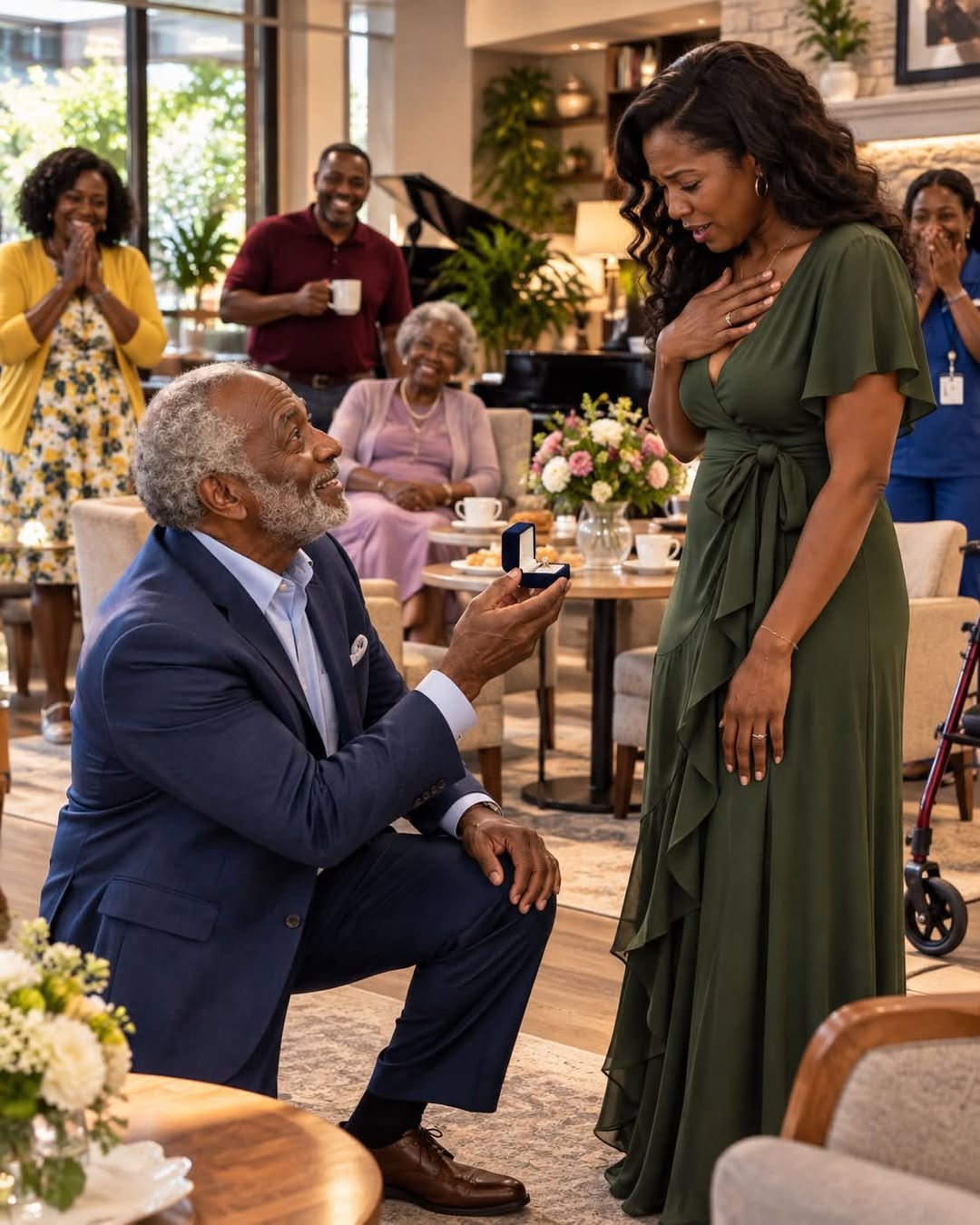
The story of Albert’s proposal became legend at Willow Creek.
New residents heard about it.
The details grew every year.
Eventually someone claimed he proposed with a five-carat diamond.
Albert never corrected them.
PART 23
On his ninety-first birthday, we held a party.
He wore a suit.
I brought a chessboard-shaped cake.
He complained that the pieces were arranged incorrectly.
Halfway through the party, he tapped his glass.
Everyone went quiet.
“I have an announcement.”
I groaned.
“No.”
He looked at me.
“Claire, I have reconsidered.”
The room erupted before he finished.
He laughed.
“I am withdrawing my marriage proposal.”
Applause.
I placed a hand over my heart.
“I’m devastated.”
“You had two years.”
“I needed more time.”
“Women.”
Everyone laughed.
Then Albert raised his glass.
“To second lives.”
The room became quiet again.
PART 24
“To the lives we think are over,” he continued, “and the annoying people
who prove otherwise.”
He looked at me.
I cried.
Later, while we sat alone, I asked:
“Why me, really?”
He knew what I meant.
Not Daniel’s documents.
Not the trust.
Why had he chosen me to carry this strange responsibility?
Albert considered.
“Because the first day you came here, you sat with Evelyn Porter for
forty minutes while she told you the same story four times.”
I remembered Evelyn.
“She had dementia.”
“Yes.”
“You noticed she became happy every time she reached the ending.”
I looked down.
Albert said:
“You listened like the story was new each time.”
PART 25
“That’s why?”
“That’s when I knew what kind of person you were.”
I shook my head.
“You barely knew me.”
“Old people become efficient.”
Then:
“Daniel chose you too.”
My eyes filled.
“Not for the money. Not for paperwork. He chose you for his life.”
Albert touched my hand.
“Don’t let the way he died make you forget the way he lived.”
That sentence stayed with me longer than anything in the safe-deposit
box.
PART 26
Albert died at ninety-three.
Peacefully.
In his sleep.
I was not there.
For a long time, that bothered me.
Then I remembered how often grief had taught me that love does not
require witnessing the final second.
His nephew gave me a small envelope.
CLAIRE.
Inside was a chess pawn.
And a note.
You still owe me an answer.
I laughed while crying.
Below it:
For the record, I would have been an excellent husband.
Then:
Keep showing up.
That was Albert.
PART 27
The companionship initiative expanded to three facilities.
Then five.
We trained volunteers to listen rather than perform kindness.
That distinction mattered.
Older people did not need to become inspirational props.
They needed relationships.
Some residents wanted conversation.
Some wanted chess.
Some wanted someone to sit quietly through baseball.
One man wanted a volunteer to help organize forty years of fishing
photographs.
A woman named Ruth wanted someone to read mystery novels aloud because
her eyesight had deteriorated.
Loneliness had many forms.
So did companionship.
PART 28
Years after Albert’s death, Willow Creek renovated the room where he
proposed.
The director asked whether I wanted a plaque.
I said no.
Then changed my mind.
The plaque did not mention money.
Or Daniel.
Or marriage.
It said:
ALBERT MERCER ROOM
KEEP SHOWING UP.
Underneath, in smaller letters:
CHESS PLAYERS BEWARE.
He would have approved.
Probably after complaining about the font.
PART 29
I eventually remarried.
Not Albert.
He would have been offended by the clarification.
His name was Samuel Reed.
A widower.
A retired high-school principal.
We met through the companionship program because he volunteered to read
newspapers to a resident with low vision.
Our relationship took time.
The first time Samuel asked me to dinner, I said:
“You should know an eighty-nine-year-old man once proposed to me in
public.”
Samuel answered:
“That is difficult competition.”
I knew immediately I liked him.
PART 30
Before Samuel and I married, I told him everything.
Daniel.
Albert.
The money.
Marcus.
The strange proposal.
The years of grief.
No secrets waiting for the wedding night.
Samuel listened.
Then asked:
“Do you still love Daniel?”
“Yes.”
“Good.”
I stared.
He smiled.
“I’m not applying for a vacancy.”
That was when I knew.
Love after loss did not erase what came before.
It expanded the house.
EPILOGUE
When Albert Mercer lowered himself onto one knee at eighty-nine and
asked me to marry him, I thought he was joking.
He was.
And he wasn’t.
He never truly expected me to become his wife.
He needed me to listen.
He needed to fulfill a promise to Daniel.
He needed to place a forgotten piece of my husband’s life back into my
hands.
But Albert gave me something larger than documents.
He interrupted my grief.
Not by curing it.
Not by telling me to move on.
By making me curious again.
Curious about why Daniel knew him.
Curious about what the papers meant.
Curious about the residents around me.
Curious about whether the rest of my own life might still contain
something I could not predict.
That curiosity saved me.
For months after Daniel died, I had thought survival meant enduring one
empty day after another.
Albert taught me survival could also mean allowing the next day to
surprise you.
The royalty money helped build a program.
Daniel’s letter gave that money direction.
But Albert gave me the courage to participate in the world again.
Years later, when people asked how the companionship initiative began, I
usually told them:
“With a terrible marriage proposal.”
They laughed.
Then I told them the real beginning.
A grieving widow walked into a retirement home because her house was too
quiet.
An old man invited her to play chess.
She kept coming back.
That was all.
No miracle.
No grand plan.
Just Wednesday after Wednesday.
Tea.
Stories.
Arguments.
Laughter.
Presence.
Albert was right in the end.
Most broken things are not repaired by one enormous gesture.
Sometimes they are repaired because somebody keeps showing up.
And sometimes the person who changes the direction of your life is an
eighty-nine-year-old man on one knee, holding no diamond at all.
Only a photograph.
May you like
- My MIL Invited My Fiancé’s Ex to Our Wedding in a White Gown and Mocked My Scars Then My Groom Turned on the Chapel Speakers
- My husband had me sentenced to ten years for a two million dollar fraud I never committed
- MY HUSBAND SAID, “YOU WANTED TO BE A MOTHER, SO ACT LIKE ONE,” THEN LEFT ME ALONE WITH OUR SIX-MONTH-OLD TWINS AND WENT ON VACATION
- My Stepmom Copied the Prom Dress My Dying Mother Made Me Then My Date Put Her Under the Spotlight
- I was nineteen when I promised to wait for him. Fifty five years later somebody knocked on my door holding out a ring that came out of a vending machine.
A promise.
And a reason to stay for one more game.
See more on the next page